Is Delta 8 Legal In Georgia?
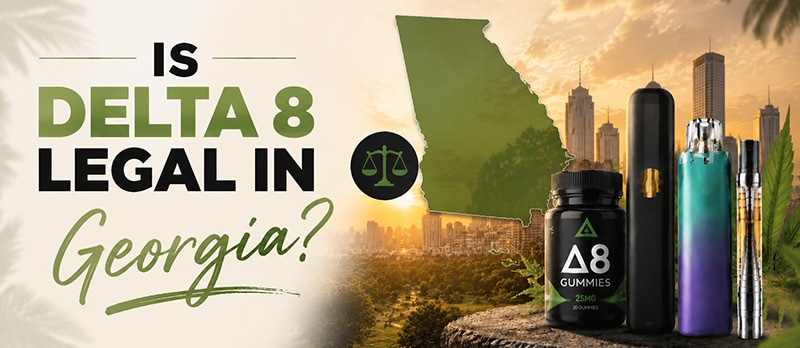
As we navigate through 2026, the question “Is Delta-8 legal in Georgia?” comes with a definitive answer: Yes, delta 8 legal in Georgia, but with rigorous, mandatory safety guardrails. The era of the unregulated, “Wild West” hemp market in Georgia is officially over, replaced by a highly structured framework enforced by the Georgia Department of Agriculture (GDA).
Knowing the legal status of hemp-derived cannabinoids in the Peach State can often feel like driving through a thick fog. One day, a product is widely available at a local shop, and the next, news headlines scream about local law enforcement raids or sweeping new legislative bills.
To be well aware of the precise fine print of these state and federal laws is crucial. Our expert guide breaks down everything you need to know, from whether you buy Delta-8 in GA, looking to purchase Delta-8 gummies for wellness, want to know if a vape product is compliant, or are concerned about how local jurisdictions handle possession.
The Short Answer: Is Delta-8 Legal in Georgia?
Yes. As of 2026, Georgia delta 8 laws, Delta-8 THC remains fully legal to purchase, possess, and consume for adults aged 21 and older in the state of Georgia, provided it meets strict criteria.
The baseline for this legality is the source material. For a Delta-8 product to be considered legal under both federal and state codes, it must be extracted from industrial hemp containing no more than 0.3% Delta-9 THC on a dry weight basis. If the compound is derived from an industrial hemp plant, it falls outside the definition of “marijuana” under the Georgia Controlled Substances Act and is classified as a legal, consumable hemp product.
However, “legal” does not mean “unregulated.” Georgia currently maintains some of the strictest consumer protection and operational rules in the southeastern United States.
The Legislative Catalyst: How SB 494 Reshaped the Market
To understand why your shopping experience looks different today than it did a few years ago, we must look at Senate Bill 494 (SB 494). Signed into law by Governor Brian Kemp, SB 494 amended the Georgia Hemp Farming Act (O.C.G.A. § 2-23-1 et seq.) and went into full effect late 2024 and throughout 2025.
SB 494 stepped into that chaos to clear up the gray market, implementing a strict regulatory architecture designed to protect public safety while keeping the market open for legitimate businesses.
The Core Mandates of SB 494:
The Over-21 Rule: It is strictly illegal to sell, distribute, or give consumable hemp products to anyone under 21 years of age. Retailers are legally obligated to perform rigorous age verification for both in-store and online checkout.
Strict Location Restrictions: No person or entity may operate a retail establishment that sells consumable hemp products within 500 feet of any school (kindergarten through grade 12).
The “No-Lure” Marketing Rule: Under O.C.G.A. § 2-23-9.2, manufacturers are completely barred from selling hemp products that resemble traditional snack foods, popular candy brands, or use cartoon characters. Gummies cannot be shaped like bears, worms, or popular treats that might attract children.
State Retail Licensing: Any shop selling Delta-8 must hold a valid Consumable Hemp License issued by the Georgia Department of Agriculture. Operating without one is a misdemeanor criminal offense.
Georgia’s 2026 Product Standards and Potency Caps
If you are buying Delta-8 or other hemp-derived cannabinoids within state lines, your products must fit inside a precise box of statutory limitations. The GDA strictly monitors these limits to prevent extraordinarily high-potency products from circulating unchecked.
The U.S. FDA Warnings and the Importance of Clean Manufacturing
The primary reason Georgia shifted from zero regulation to high enforcement stems directly from health and safety concerns highlighted by the federal government. The U.S. Food and Drug Administration (FDA) has issued repeated public warnings regarding the manufacturing of Delta-8 THC across the nation.
Unlike Delta-9 THC, which is produced naturally in abundant quantities by the cannabis plant, Delta-8 is a minor cannabinoid. To create enough Delta-8 for commercial vapes, concentrates, and edibles, manufacturers must use a chemical process to convert hemp-derived CBD into Delta-8 distillate.
Why Unregulated Delta-8 is a Risk:
Contaminated Environments: The FDA notes that because the market grew unchecked through loopholes, some manufacturing occurs in uncontrolled or unsanitary laboratory settings.
Household Chemical Residue: The conversion process requires an acid catalyst. If a manufacturer is cutting corners or lacks professional oversight, the final product may contain residual solvents, heavy metals, or potentially harmful household chemicals used to alter the color or viscosity of the oil.
Misconception of Safety: Many consumers mistakenly believe that because a product is labeled “hemp,” it is completely non-intoxicating and entirely natural. Delta-8 is psychoactive, and without strict state standards, consumers have no way of knowing what they are truly putting into their bodies.
To counteract these manufacturing risks, delta 8 legal in Georgia mandates that every single package of consumable hemp must feature a clearly visible QR code. When scanned, this code must lead directly to a third-party Certificate of Analysis (COA).
Understanding the “Total THC” Metric and the THCA Ban
One of the most significant changes implemented in the updated Georgia Delta 8 Law regulatory code is how state laboratories calculate THC concentration. Previously, retailers took advantage of a legal loophole by selling raw cannabis flower that was high in THCA (Tetrahydrocannabinolic Acid). Because THCA is the raw, non-psychoactive precursor to THC that only converts into psychoactive Delta-9 when heated (such as smoking a pre-roll), sellers argued it was legal hemp under the strict letter of the old definitions.
Georgia slammed that loophole shut by introducing the “Total THC” calculation standard.
State enforcement agencies now utilize a post-decarboxylation mathematical formula to evaluate a product’s legality:
Total THC = Delta-9 THC + 0.877 THCA
If the combined percentage resulting from this formula exceeds the 0.3% dry weight limit, the product is legally categorized as marijuana rather than hemp. This calculation has effectively removed raw high-THCA hemp flower and pre-rolls from standard retail shelves across the state, focusing the legal market strictly on compliant, precision-dosed manufactured items like sublingual tinctures, topicals, and clear-cut edibles.
The Impending Shift: What You Must Know About Federal and State Updates
The legal environment for hemp-derived products is not stationary. In fact, the entire national industry is facing a major regulatory reckoning.
The Federal Funding Bill Amendment
In late 2025, a federal restriction was embedded into a sweeping government funding bill, aimed at completely rewriting the loose definitions established by the old 2018 Farm Bill. This federal update establishes an aggressive cap of just 0.4 milligrams of total THC per final package container for any product crossing state lines or utilizing interstate commerce channels.
Because standard commercial gummy packages contain significantly more than 0.4mg across a whole container, this federal rule essentially initiates a massive phase-out of traditional high-potency over-the-counter hemp products. This amendment features a transition runway that sets a hard compliance deadline for November 12, 2026.
Georgia’s Legislative Response: SB 33 and SB 220
Georgia lawmakers did not wait around for the federal clock to tick down. During the 2026 legislative session, the General Assembly advanced two massive pieces of legislation to completely change how residents access cannabinoids.
Senate Bill 33 (SB 33): This bill targets completely synthetic or altered cannabinoids like HHC (Hexahydrocannabinol) for absolute elimination from the consumer market by 2027. While it leaves naturally occurring hemp options tightly regulated for the moment, it prepares Georgia’s code to lock into the incoming ultra-restrictive federal container limits, putting immense pressure on standalone smoke shops.
Senate Bill 220 (The Putting Georgia’s Patients First Act): Recognizing that thousands of residents rely on these compounds for personal wellness, Georgia simultaneously passed an unprecedented, massive expansion of its Medical Cannabis Program. Signed into law in May 2026, SB 220 eliminates the old, restrictive 5% concentration cap on medical oils. It establishes a robust 12,000-milligram therapeutic possession limit for registered patients, authorizes medical vaporization for individuals 21 and older, and permits direct-to-patient educational marketing.
A Consumer Checklist: How to Buy Safely and Legally in Georgia
Can you buy delta 8 in GA? If you choose to use Delta-8 products in Georgia today, you must be a smart, proactive consumer. Walking into a random corner shop and picking up an unvetted package carries real legal and health risks. Use this compliance checklist before you make any purchase:
Verify the Age Gate: If a retail storefront or online vendor does not strictly ask for physical identification or use a digital age-verification tool at checkout, they are breaking Georgia law. Avoid them.
Pass the QR Code Litmus Test: Look at the back of the packaging. There must be a clear QR code that routes directly to a verified, third-party Certificate of Analysis. Ensure the lab report is less than 12 months old and shows a “PASS” for heavy metals and residual solvents.
Examine the Packaging Aesthetics: Compliant brands will use professional, minimalist packaging. If the bag mimics a candy brand, features bright cartoon mascots, or displays wild, unsubstantiated health claims (e.g., “Cures Insomnia” or “Treats Chronic Pain”), it is illegal in Georgia.
Confirm the Vendor License: Don’t hesitate to ask a shop owner if they possess a valid Consumable Hemp License from the Georgia Department of Agriculture. Reputable retailers keep this documentation prominently displayed.
Traveling and Transporting Delta-8 Safely Within the Peach State
If you already own legal, compliant Delta-8 products and need to travel within Georgia’s borders, you should follow responsible practices to avoid any misunderstandings with law enforcement.
Because an untested edible or oil can look identical to an illicit marijuana product, police officers cannot always tell the difference on sight. If you are stopped or pulled over, an unlabelled product could be subject to confiscation and sent to a lab for expensive testing, leaving you tied up in an unnecessary legal headache.
Rules for Safe Transport:
Keep Original Packaging Intact: Never dump your Delta-8 gummies into an unlabelled plastic bag or travel container. Keep them in their original retail container displaying the manufacturer name, ingredient profile, and mandatory QR code.
Store in the Trunk: Treat your hemp products the same way you would treat an open container of alcohol or prescription medication. Store them safely out of sight in your vehicle’s trunk or rear cargo area.
Never Consume and Drive: Driving under the influence of Delta-8 THC is strictly illegal. Georgia’s strict impaired driving laws apply fully to hemp-derived cannabinoids, and operating a motor vehicle while impaired will land you a DUI charge.
Keep a Digital COA Ready: Keep the product’s lab report bookmarked or downloaded as a PDF on your smartphone. If a local official questions the legality of your product, showing them a clean, compliant full-panel COA provides immediate proof of industrial hemp status.
Frequently Asked Questions (FAQ)
Can I buy Delta-8 online and have it shipped to Georgia?
Yes. You can legally purchase Delta-8 products online from national brands and have them shipped directly to your Georgia home.
Will Delta-8 show up on a Georgia workplace drug test?
Yes. Because the standard workplace drug screenings do not look for the specific cannabinoid variant, they screen for the presence of the primary metabolic byproduct of THC.
Can I travel across state lines into Georgia with Delta-8?
Yes, as long as the product is fully derived from industrial hemp (containing less than 0.3% Delta-9 THC), complies with the “Total THC” metrics, and you are of legal age (21+).
What are the penalties if I am caught with a non-compliant product?
If law enforcement discovers you in possession of a product that lacks a verified lab report, or one that exceeds the 0.3% Total THC threshold, it will be treated as illicit marijuana under the Georgia Controlled Substances Act. Depending on the weight of the item, possession can result in a misdemeanor charge (punishable by a fine of up to $1,000 and up to 12 months in jail) or an automatic felony charge for quantities over an ounce.
Final Inference
By now, you are clear that “is delta-8 legal in Georgia?” Well, Georgia has now established that it is no longer a lawless “no-man’s land” for alternative cannabinoids. By taking credible majors, the state has built a highly enforced system with clarity to push low-quality, copycat products out of the market while keeping clean, well-formulated, transparent options available for responsible adult consumers.
Later this year, as federal deadlines approach and medical programs expand across the state via SB 220, the cannabinoids dimension will continue to shift toward safety, transparency, and consumer education. By staying well-informed, skipping the “gas station specials,” and insisting on strict third-party lab verification, you can confidently and legally access the world of Delta-8 in Georgia.