Is Delta 8 Legal in California?
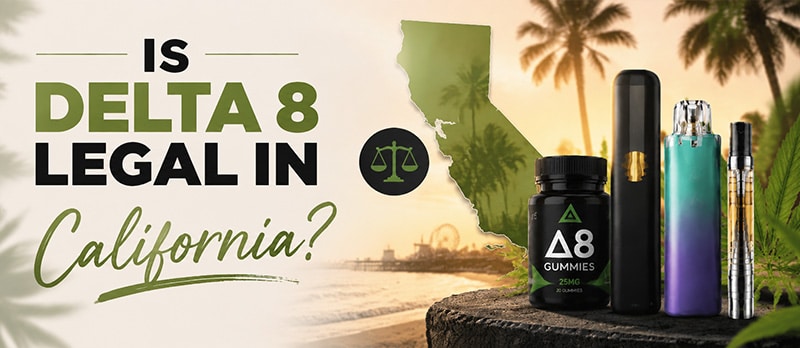
Delta 8 THC has been one of the most talked-about hemp-derived compounds on the market. But ask around, “Is Delta 8 THC legal in California?” and you’ll get a different answer every single time. One person says delta 8 legal in california because of federal rules, while another warns you that it’s completely banned by the state. This legal flip-flopping makes it incredibly stressful to know whether you can safely buy your favorite Delta 8 gummies, tinctures, or vapes.
The reality in 2026 is tight, aggressive, and rapidly closing loopholes. Due to a historic regulatory squeeze matching state-level enforcement with brand-new federal legislation, delta 8 california has shifted from a legal gray area to a strictly locked-down marketplace.
Don’t worry, we are here to cut through the legal static. This comprehensive guide delivers the definitive, data-driven facts to the answer is delta-8 legal in California? so you can shop safely and enjoy legal alternatives with absolute certainty.
Key Takeaways: The 2026 Delta 8 California Reality Checklist
Unregulated Sales are Banned: You can no longer legally buy Delta 8 at gas stations, convenience stores, or smoke shops in California.
The “Zero Detectable THC” Mandate: California emergency rules, made permanent through Assembly Bill 8 (AB 8), explicitly ban any consumable hemp product containing any detectable level of total THC per serving outside of the licensed cannabis track-and-trace dispensary system.
The Smart Pivot: If you are looking for legal, safe, and premium psychoactive or wellness options, you must buy from highly reputable sources like MyDelta8Store or pivot to ultra-pure, 100% legal alternatives like lab-tested CBD isolates and compliant cannabinoids.
Is Delta 8 Legal in California?
According to the official Los Angeles County Department of Public Health Delta-8 Factsheet, commercial Delta 8 is a synthetic illusion. Because it only occurs in uselessly trace amounts in raw cannabis, the product sitting in your drawer right now was manufactured through an aggressive chemical conversion process using harsh, artificial acids to synthetically alter hemp-derived CBD.
Even worse, health officials have issued a massive “Buyer Beware” warning for delta 8 california: because this unregulated chemistry often happens in unsanitary settings, consumers are routinely exposed to toxic, unreacted manufacturing solvents, heavy metals, and illegal, hidden potencies.
That is exactly why California has completely slammed the door shut. Under the state’s uncompromising emergency regulations and Phase 1 mandates, the sale of any consumable hemp product containing any detectable amount of THC is strictly prohibited in California.
Gas station corner stores and vape shops are facing massive $1,000 to $2,000 fines and permanent license revocation for carrying these synthetic isomers.
The Wild West era of unregulated “weed-light” is officially dead.
But here is the good news: you do not have to give up your wellness routine or sacrifice your peace of mind. While the state has completely wiped toxic, synthetic psychoactives off mainstream shelves, ultra-pure, 100% legal, zero-THC cannabinoid isolates remain fully authorized and safer than ever.
It is time to upgrade your routine. Discover our third-party lab-verified, pristine, and fully California-compliant formulations that deliver the deep, natural relaxation you crave completely legally, safely, and transparently!
Navigating the 2026 California Delta 8 Squeeze
To understand why the marketplace changed so drastically and how you can protect your wallet, health, and freedom, let’s break down the current scenario about delta 8 legal in california.
The Sudden Crackdown on California Shelves
For years, Delta 8 products sat openly on the shelves of neighborhood vape shops from Los Angeles to San Francisco. Consumers assumed that because these items were derived from hemp, they were protected by the federal 2018 Farm Bill.
However, everything shattered when Governor Gavin Newsom announced a sweeping emergency regulatory package targeting intoxicating hemp-derived compounds. The California Department of Public Health (CDPH) and the Department of Alcoholic Beverage Control (ABC) immediately initiated aggressive enforcement stings, seizing thousands of non-compliant products and leaving retail shelves completely bare. If you try to buy standard Delta 8 in California today outside a regulated dispensary framework, you will face locked doors and empty displays.
Decoding the Data-Driven “Squeeze”
Why did California regulators take such drastic measures? It comes down to a multi-billion-dollar legal clash and serious public health warnings.
According to a comprehensive financial impact analysis detailed by McElfresh Law, the state-level ban on unregulated hemp-derived THC products is projected to strip more than $2 billion in revenue from the unregulated hemp sector over its first five years. The strict rollout is designed to eliminate an estimated $2 billion “shadow market” and force all intoxicating cannabinoids into California’s heavily taxed, highly regulated, and unionized adult-use cannabis framework.
| Regulatory Milestone | Effective Date | Core Legal Impact |
|---|---|---|
| CDPH Emergency Regulations | September 23, 2024 | Instated a 21+ age limit, 5-serving package caps, and banned any detectable total THC in general retail ingestibles. |
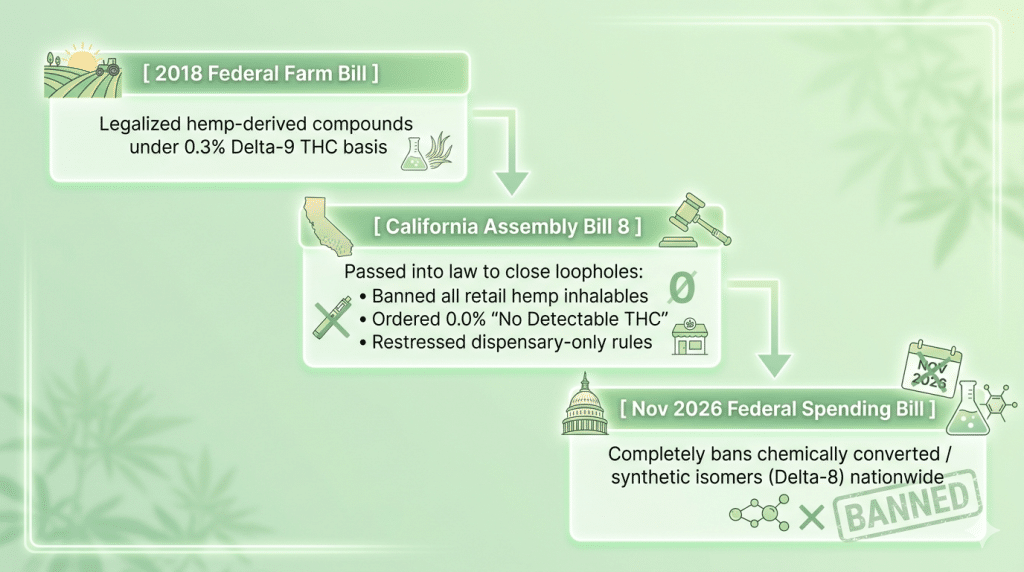
| Assembly Bill 8 (AB 8) – Phase 1 | January 1, 2026 | Banned all smokable hemp and inhalables; mandated a 99%+ zero-THC purity standard for general retail hemp extracts; prohibited tobacco retailers from storing or selling hemp THC. |
| Federal Spend Bill (H.R. 5371) | November 12, 2026 | Explicitly removes synthetically converted or isomerized cannabinoids (like Delta 8 and Delta 10) from the definition of legal hemp nationwide. |
The Craving for Clean, Compliant, and Verified Products
Consumers do not want to stop enjoying the relaxing, balancing benefits of cannabinoids, they just want to know is delta 8 thc legal in California and do it without breaking the law or consuming hidden chemicals. The structural appeal of Delta 8 was always its “milder high” compared to Delta 9 THC.
Because Delta 8 has its double carbon bond on the eighth chain instead of the ninth, it offers a functional, body-focused wave of relaxation without triggering the intense cerebral headiness or paranoia often tied to traditional marijuana.
You deserve to experience that deep peace of mind. However, true relaxation is impossible when you are worrying about whether a product is contaminated, mislabeled, or flat-out illegal. The desire for absolute product purity, verified third-party lab results, and ironclad regulatory compliance has never been higher.
How to Smartly Shop and Pivot Right Now
The era of buying mystery hemp products from local gas stations is dead. To protect yourself and ensure you are buying safe, premium, and fully authorized products, you must take immediate, assertive action:
Insist on a Certificate of Analysis (COA)
Never spend a single dollar on a product that does not feature a prominent QR code linking to an independent, third-party lab report verifying exact potency and proving the batch is 100% free from heavy metals, residual solvents, and synthetic bleaches.
Purchase Exclusively from Licensed Retailers
If you want intoxicating cannabinoids in California, you must buy them through state-licensed dispensaries monitored by California’s METRC track-and-trace system.
Pivot to Pure Isolates
If you prefer shopping through standard retail channels or online e-commerce platforms, focus exclusively on ultra-pure brands offering greater than 99% pure CBD or CBN isolates with verified zero-THC formulas, which remain fully legal under AB 8.
Factsheet Breakdown: Los Angeles County Department of Public Health Warnings
To understand the health-driven motives behind California’s aggressive legislation, we must examine the formal warnings issued by local health agencies. The Los Angeles County Department of Public Health (LADPH) Delta-8 Factsheet explicitly outlines why regulators stepped in to halt the unregulated sale of these compounds.
The Chemical Manufacturing Trap
The LADPH factsheet highlights a critical misconception: while Delta 8 THC occurs naturally in cannabis and industrial hemp plants, it only does so in miniscule, trace amounts. It cannot be cost-effectively extracted directly from the plant.
Instead, the commercial Delta 8 found in retail products is almost exclusively manufactured through a synthetic chemical conversion process, where manufacturers use strong acids and chemical catalysts to alter the structure of hemp-derived CBD isolate.
Severe Public Health and Safety Concerns
Because this chemical isomerization process has long occurred in an unregulated market, public health officials uncovered severe quality control issues:
Harmful Impurities
The chemical conversion process often leaves behind dangerous residual manufacturing byproducts, including unreacted solvents, strong acids, and unknown synthetic isomers that have never been evaluated for human safety.
Lack of Standardized Testing
Many products sold in gas stations and smoke shops were found to contain significantly higher potencies of THC than advertised, or were cross-contaminated with heavy metals and agricultural pesticides.
Accidental Pediatric Poisoning
Unregulated Delta 8 products were frequently packaged in bright, candy-like wrappers that explicitly appealed to children. This lack of child-resistant packaging triggered a dramatic surge in accidental pediatric ingestions and emergency room visits across California.
These stark findings are precisely why California passed AB 8, forcing these products off mainstream retail shelves and moving them exclusively into the strictly tested, child-proof cannabis dispensary pipeline.
Federal vs. State Law: The Ultimate Regulatory Squeeze
Navigating the crosswinds of federal and state laws can feel dizzying, but looking at the actual legal framework clarifies the situation.
The Federal Loophole
Federally, the 2018 Farm Bill legalizes industrial hemp and its derivatives as long as the product maintains a Delta 9 THC concentration of no more than 0.3% on a dry weight basis. The federal text failed to account for other emerging THC isomers like Delta 8, Delta 10, or HHC, accidentally creating a massive loophole for national e-commerce shipping.
The California Defense
California countered this loophole by enacting its own rigorous standards. Under California Cannabis Regulations, state laws take precedence within California borders.
The passage of AB 8 ensures that regardless of federal dry-weight percentages, any hemp product containing any detectable level of total THC (including Delta 8, Delta 10, and THCA) is classified as an intoxicating cannabis product.
Consumer Protection: How to Verify Real Quality and Safety
Because the legal landscape is shifting rapidly, the burden of safety falls squarely on your shoulders. If you are ordering hemp products or legal alternatives online to a California address, you must act as your own compliance officer. Here is the exact checklist you need to execute before entering your credit card details:
1. Read the Certificate of Analysis (COA) Like a Pro
A legitimate, high-end cannabinoid brand will always display an up-to-date, batch-specific COA directly on their website. If you cannot find a lab report, close the tab immediately. When reviewing a COA, verify the following three data points:
The “Total THC” Profile
Ensure the lab explicitly details the concentration of all active isomers. For standard retail compliance in California, the total detectable THC must register at 0.0%.
The Testing Lab’s Credentials
Look for a stamp from an ISO/IEC 17025 accredited third-party laboratory. This proves the testing facility meets stringent international scientific standards and is completely independent of the manufacturing brand.
The Contaminant Pass/Fail Matrix
Scroll past the cannabinoid percentages and look closely at the safety panels. The product must display an unambiguous “PASS” rating for residual solvents (like butane, hexane, or acetone), heavy metals (lead, arsenic, cadmium, mercury), pesticides, and microbials (mold, salmonella, E. coli).
2. Evaluate the Extraction Methodology
Premium brands are incredibly transparent about how their products are made. Look for companies that employ advanced Supercritical CO2 Extraction or highly refined ethanol extraction methods. Avoid brands that rely on cheap chemical conversions, as these are the primary sources of the toxic manufacturing impurities highlighted by public health departments.
Crucial Safety and Workplace Precautions
Enjoying cannabinoids responsibly means understanding exactly how they interact with your daily obligations, professional livelihood, and physical safety.
The Drug Test Trap: Will Delta 8 Make You Fail?
This is a critical warning for all workers in California: Yes, consuming Delta 8 THC will absolutely cause you to fail a standard workplace drug test. Most common drug screenings utilize basic immunoassay tests designed to detect the primary metabolites of THC. These standard screenings are not sophisticated enough to differentiate between legal, hemp-derived Delta 8 and illegal, marijuana-derived Delta 9. To the testing panel, THC is simply THC.
Even though California has passed laws protecting employees who consume off-duty recreational cannabis, federally regulated positions, transportation jobs (DOT), construction fields, and safety-sensitive roles are completely exempted from those protections. If your job depends on regular drug screenings, you must avoid Delta 8 entirely.
Driving, Heavy Machinery, and Legal Risk
Because Delta 8 binds directly to your body’s CB1 endocannabinoid receptors, it alters cognitive function, impairs depth perception, slows motor coordination, and delays your reaction times.
Operating a motor vehicle or heavy industrial machinery while under the influence of Delta 8 is highly dangerous and completely illegal. Getting caught driving under the influence of hemp-derived cannabinoids carries the exact same severe criminal penalties, court fines, and permanent driver’s license suspensions as a standard alcohol or cannabis DUI. Always enjoy your premium products in a safe, controlled, and stationary environment.
The Dynamic Future of the West Coast Market
The enforcement actions taken by California are reshaping the landscape of the entire West Coast hemp market. What was once an unchecked wild-west industry has compressed into a sophisticated, highly localized system.
Over the next few years, industry experts project that the remaining multi-state hemp brands will completely bifurcate their business models. To survive in California, companies must either invest the massive capital required to secure an official adult-use cannabis manufacturing license, or completely re-engineer their retail products to feature 99% pure, zero-THC isolates.
By cleaning up the marketplace, eliminating bad actors, and mandating pristine lab testing, these laws are ultimately paving the way for an incredibly safe, reliable, and premium consumer experience.
Choose Quality, Safety, and Absolute Legality
The days of taking risks on cheap, unregulated, and untested gas station Delta 8 products are completely over. California has drawn a clear line in the sand to protect your health and support a clean marketplace.
If you are ready to experience the true wellness benefits of premium cannabinoids without legal stress or physical risk, it is time to upgrade your routine. Take charge of your health today by choosing trusted brands that offer absolute transparency, flawless third-party testing, and legal compliance.
Don’t settle for less, demand a verified Certificate of Analysis, shop from authorized sources, and experience the premium difference of pure, pristine, and fully compliant cannabinoid formulations!
Regulatory & Government References
California Hemp Product Mandates and Legislation: Detailed statutory breakdowns of industrial hemp restrictions, manufacturing purity standards, and tobacco retailer fines under Phase 1 can be reviewed directly via the California Legislative Information Assembly Bill 8 Chaptered Text.
Emergency Cannabis Enforcement and Market Dynamics: Extensive insights on CDPH emergency rulemakings, the permanent total-THC retail bans, and multi-billion-dollar legal updates are documented by McElfresh Law – California Hemp Bans and tracked via California Cannabis Regulations News & Timelines.
Federal Legal Definitions and Exclusions: The shifting definitions of industrial hemp and the impending nationwide ban on synthetic isomers are detailed under H.R. 5371 Section 781 Congressional Directives.
Public Health Analysis & Warnings: For a full breakdown of the chemical manufacturing processes, pediatric risks, and impurities found in unregulated isomers, review the official Los Angeles County Department of Public Health Delta-8 Factsheet.